Thursday, June 12, 2014

Don't Break Your Bank!


I watched my granddaughter graduate this year, and got thinking what sort of advice I might offer those young men and women.  There are so many opportunities and endeavors ahead of them.  Being a textbook-case Cancer, my thoughts naturally turn to home, and that leads me, inevitably to my passions – caring for family, household management and thrift.  Then, I knew what I would say. Worry about your OWN bottom line, and the country will take care of itself.   Perhaps one of the greatest modern bug-a-boos is “If you don't shop, our economy will go down the toilet.”  This is an over-simplification of a complex issue.  In a FREE market, this is true.  In the highly speculative and “futures” market of today, this generalization, more often than not, hurts the individual.
 
Worry about your OWN bottom line, and the country will take care of itself.   Perhaps one of the greatest modern bug-a-boos is “If you don't shop, our economy will go down the toilet.”  This is an over-simplification of a complex issue.  In a FREE market, this is true.  In the highly speculative and “futures” market of today, this generalization, more often than not, hurts the individual.

Do not fall for it. Yes, there is absolutely a correlation between goods and services bought and sold, and the country's economic growth and stability. HoweverBut, coercive rhetoric is often employed to get the consumer to shop, shop, SHOP! It's all about the corporate bottom line, and their ability to pay desired shareholder dividends. It has little to do with saving the country’s economy, merely their own.  If individuals overspend and incur onerous debt, the country is far more vulnerable to economic meltdown and paralysis than it would be if everyone spent within their means. This fact will never satisfy the corporate appetite for ever-increasing profit margins, though.

The current trend is to sell. Sell HARD. Doesn't matter is the product is any good, or if it’s the ideal solution for the customer; it matters only that it is SOLD.  Good luck getting service, warranty or even technical support after the transaction is complete.  Despite all promotions to the contrary, know this before you purchase anything.

From time to time, I place an online order and really enjoy the ease of shopping, the variety of products, and the quick and convenient home deliveries. What I don't enjoy is getting an email, from the same vendor, a week later “wondering” why I haven’t made another purchase. Excuse me? If I need anything, I'll order. If I forget something, I'll re-order. Prompting like this is what I call anti-advertising:  the overt (to me) insatiability makes me never want to shop there again.

Perhaps the most irritating tactic by retailers is the buy "x" number and get "y" free. If a person needs only one, the others are superfluous, and thereby offer no savings, but waste. The only exception being, when those items store well and are intended for eventual use, then consider the extra items. Otherwise, the purchase supports the merchant’s bottom line, not your own. You're certainly not saving anything.

This first key to a balanced budget is to know the difference between want and need. Even necessary expenditures can entice us to spend beyond our means when we allow ourselves to get “up-sold” on features or modifications that are more flash than requirement.

The second key is to learn the value of your own work. In other words, how many hours did you work in order to afford that cool whatchamacallit? Would you so willingly spend those hours at work for it? If the answer is yes, then, even if it is a want, it will add to your quality of life, and that is important. However, more often than not, when you include "hours worked" in your mental calculations, it will more clearly define those wants and needs.

We all know that when spending is greater than earnings, there is deficit. Everyone concerned with balancing his or her household budget knows this. Only a rarified few, who rely on and indulge too heavily at the money-trough called ‘Consumers’ Hard Work’ fail to accept their own influence on the lingering economic malaise. Despite their fear mongering, however, restoring the economy will never depend upon your purchasing any whiz-bang thingamajig. It seems there is little any individual can do to affect this current trend of abuse and gluttony by community leaders, but there is no need to feed the beast.  So, whatever you do, don't fall for the marketing hype. Buy what you need when you need it, and save for things you foresee needing. Use credit as little as possible; save it for those emergencies when need is greatest.

The next time you feel pressured -- by corporations, by advertisers, by news broadcasters, by politicians -- ask yourself if you really NEED what they’re selling.  When shopping, ask yourself, who is best served by your purchases?


Thursday, April 10, 2014

Cut Back to Get More

Good weather has finally arrived here in Cache Creek.  Grass is greening and bulbs are sprouting.  I've spent the last two weeks alternating a day of yard work with three of recuperation.  During a recent achy day, while brainstorming ideas for this blog, I happened to look up “thrift.”  Here’s one definition by FreeDictionary.com :  … “5. an obsolete word for prosperity.”  Huh.  That led me to their definition of prosperity:  … “3.  thrift - First meant acquired wealth, prosperity, success.”  The idea resonated with me more than the usual definitions.  Then I noticed one synonym of thrift is “good husbandry” and that’s when it hit me:  Why not share the thrifty-come-prosperous work I've been doing?

Mainly, said yard work, which was pruning.  The place we rent has several perennials and trees all of which were left on their own too long and had grown rangy and tangled.  They were more than unattractive; they were blocking the light for other plants.  Worse, their crops of flowers, buds and fruits had diminished in quantity and quality.  Some had stopped producing altogether.

Slowly, over time, I've pruned the plants, and now they are becoming strong and productive once again, not to mention attractive and pest-free.  It seems contrary to cut back branches, cut down stalks, or saw away boughs, but a carefully pruned plant will actually produce better when extraneous limbs are removed.

Pruning anything, whether it be a tree, a bush or a perennial must be done at its suitable time of the year, though.  Spring and mid-winter are the most common times to prune shrubs and trees.  Some plants benefit from pruning right after summer flowering.  Many perennials or canes produce more blooms or fruit if continually dead-headed and/or harvested.

Once you have research on each plant in your plot and their varying requirements for pruning and trimming, you can make notes on your calendar.  I like a quick review before pruning, though.  Some plants can be cut right down to the ground; others to specific limb-joints.  Some benefit from the old or main stock being preserved while others are cut back to allow new growth to replace it.  Far too much information for me to recall without a brief refresher referencing one of my gardening books.


Oh, and one little reminder – I seem to forget this each spring – before you head out to do any yard work, remember to do a five minute warm-up.  It’ll save you some Epsom salts.  : /


Thursday, February 13, 2014

Spice It Up This Valentine’s Day

Where I live, in western Canada, Valentine's Day usually comes at the coldest time of the year, almost without fail during the last wintry blast of the season.  While both Valentine’s Day and cold weather are excellent excuses for snuggling with your Sweetheart, when you both suffer arthritic pain, romantic gestures are just not as…cozy.  Hand-holding can be downright terrifying.  Hubby and I, diagnosed with Rheumatoid and Osteo-arthritis, have found a few home remedies that give us relief.

The best – and the most difficult – remedy was an exclusion, yet the results for Hubby were dramatic.  He once had a 1400 ml per day soda habit, plus he enjoyed candy and sweet treats.  When I showed him the research I'd found on the negative effects of refined sugars on arthritic pain, he began cutting back.  After a brief period of withdrawal, Hubby noticed a lessening in both the intensity and frequency of his pain episodes.  That convinced him.  Now, he rarely drinks soda, and continues restricting his consumption of sweets, candies, and alcohol (which is, essentially, another source of refined sugar.)  As a result he suffers only rarely, often during the most frigid days of winter.

That's when I employ a few soothing foods and there are several which have been shown to either exacerbate or alleviate symptoms of arthritis.  Long ago, we eliminated or restricted those aggravating foods, and being a firm believer in the healing benefits of whole and natural foods, I was eager to use foods shown to have healing or soothing properties.  Really, it was an easy choice.  Since I have limited my intake of salt/sodium, the task of heightening flavours has been taken over by spices and herbs.  So, garlic, ginger, turmeric and cinnamon, (along with many other spices) were already ever-present in our diet.  Learning of their arthritic pain-relieving properties, we quite happily bumped up our use of those four powerhouse spices.

The most common home-remedy we use is a Cinnamon spread:  one part organic cinnamon to three parts
pure honey.   Some sources recommend a twice-daily cinnamon and honey hot drink, while others debunk it as ineffectual.  We use good quality organic cinnamon mixed with pure honey from a known and reputable source, and enjoy the mixture regularly, if not daily, slathered on morning toast or dolloped into tea.  In doing so, we find joint stiffness and swelling are reduced and we maintain relatively smooth ease of motion.

Ginger and garlic have long been staples of our diet, but when the situation calls for it, I’ll use massive amounts of both to “dose up” a batch of my "Healing Soup" -- a home-made ramen-style soup loaded with veg in a hearty and spicy stock – to alleviate bouts of Arthritic pain, or even to ease an upset stomach.  We're also big fans of curries, so turmeric and garlic are also used in similar Asian-style dishes, but turmeric’s effect seems more subtle than cayenne.

Ahh…that little red chili pepper!  Cayenne has quickly become our drug of choice, though we don't use the capsaicin cremes or ointments.  We simply add minced pepper, fresh or dried, to whatever we're cooking.  Its pain-relieving effect was so pronounced, I grew a few plants last summer.  Prior to that, we rarely consumed spicy foods as we both suffered heartburn.  However, when eaten in moderation – I use about 1/3 to 1/2 of a cayenne pepper for a 2-4 portion meal – there is only a mild and pleasing heat, a brighter flavour than black peppercorn, and no heartburn.  Not only does it relieve pain, it also warms the body!

There are other foods said to help with Arthritic pain -- cherries (fresh, canned, or dried), borage, fish oils high in omega 3 & 6, alfalfa seeds, and Ginkgo Biloba -- but we have little or no experience with these.  Well, we eat fish, regularly, and some of it (when we can get it) is high in those omega fats; and we do eat cherries, occasionally, throughout the summer; but we haven’t noticed any marked difference in our levels of pain or mobility after eating either.  That, however, could be due entirely to our infrequent consumption of them.

Regardless, there are many ways a person can relieve symptoms of arthritis, and not all of them come from a medicine cabinet.  If you or a loved one is suffering with stiff, sore, arthritic joints, and the thought of holding hands makes you want to run screaming, try warding off the chilly with the chili.  Or perhaps some Cinnamon Spread instead of the usual Valentine sweets?  Maybe a romantic dinner at a Thai restaurant where they use plenty of garlic, ginger, and chili peppers?

You know…spice things up a little!  ;)


Thursday, December 12, 2013

8 Ways to Save Bread

A Canadian Grocer article caught my attention.  It’s about two film makers’ experiences with dumpster diving and food waste.  What an eye-opening read.  One shocking statistic, I thought, was the amount of wasted bread.  That 13% includes waste from bakeries – not just food from households – but that amount of baked goods thrown away is still alarmingly high.

Our own kitchen was once an example of why.  When our children left home, we couldn't get through a loaf of bread before it dried out or went mouldy.  Week after week, we would waste another partial loaf.  After a few months of that, I was looking for better ways to store bread.

The solution was simple and is still in use.  We freeze fresh, sliced loaves of our favourite breads and remove slices, only as needed.  It takes some forethought as the bread requires about half an hour to thaw, but then it’s as soft and tender as it would normally be -- although, thawing should be done in a sealed container to prevent drying.  We haven’t wasted a loaf since!

Here are seven more ways to reduce bread waste (crusts work well for a few of these):

1)      Stuffing:  use day old or dry bread – absorbs flavours without loosing body.
2)      Melba Toast:  use dry bread from uncut loaves; cut into thinnest possible slices; remove crusts; bake in a 250 degree until crisp and golden and all moisture is withdrawn; store in cool, dry, place.
3)      Panade (soup thickener):  fresh or dry bread; blend into soups or stews to thicken; combines well with leek, celery, sorrel, watercress, spinach and cabbage soups.
4)      Bread sauce:  dry, finely-ground bread crumbs are substituted for flour in pan sauces; best served with wild bird or roasted meats.
5)      Bread pudding:  use dry bread or stale cake.
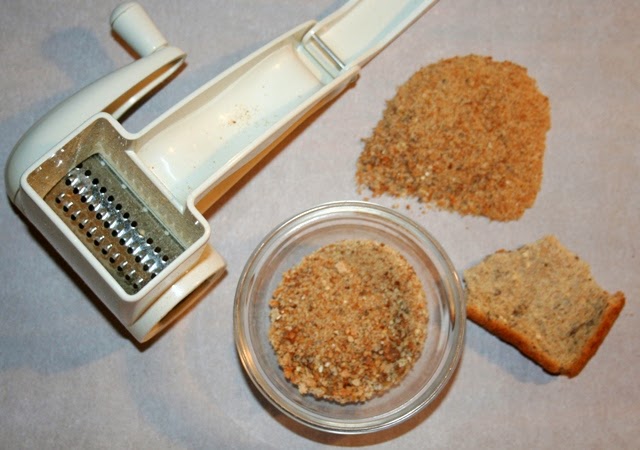
6)      Bread crumbs:  use dry bread – if not dry enough, bake in a 200 degree oven until crisp; grind and then store in a cool, dry place in a container not too tightly lidded (to prevent moulding.)  A rotary hand grater works well when only a small amount of crumbs are needed.  Cookie crumbs can be made similarly and are a tasty addition to some desserts. 
7)      Croutons:  dice fresh or dry bread, sprinkle with your favourite cooking oil, herbs and spices and bake in a 375 degree oven until crisp and golden.


With the holidays coming, I’ll be employing a few of these uses.  My “crust collection” from various breads will stuff the turkey, and I have plans to make Melba toast from the heel of one of the Pumpernickel loaves I’m baking.  It’s time to refill our bread crumbs, too, for topping the turkey casserole, so I might just grab a loaf from the clearance rack at our local bakery – we rarely have enough dry bread at home anymore.


Thursday, October 10, 2013

Cleaning Up

Fall cleaning is the absolute worst.  Something about having windows and doors open through the summer
adds an extra-stubborn layer of desert dust and sagebrush pollen to the house.  This year, I’m experimenting, using home-made cleaners, exclusively.  Along with old standbys like this glass cleaner and these furniture polishes I've added a few new cleaners.  The results, so far, are astonishing!

Though this blog deals with thrift, the monetary savings, of using homemade rather than my usual store-bought cleaners, are not huge.  The cost of homemade cleaners varies based on cost of individual ingredients and the quantities used of each.  Regardless the formulation, though, all the homemade products I’m using cost less, per use, than their store-bought alternative – which I (once) bought in bulk for maximum economy.  Despite modest savings, that’s not what prompted the switch.  This year, I was interested in using milder ingredients which might prove gentler on sensitive skin and the environment (both indoors and out.)

The problem is, I’m a bit of a clean freak and if these homemade products didn't work, I’d likely break down and buy some environmentally friendly commercial product which would.  It turns out, I don’t have to make that choice.  The cleaners and polishes work as good as or better than all the old products I previously used.

For example, our bathroom had accumulated calcium/mineral deposits dating back prior to our arrival.  I've been working at them, scrubbing furiously, trying to remove that dull coating.  Nothing I used touched it, though.  Then, a few weeks ago, I tried this tub & tile cleaner and, with far less hard work, our tub is actually glossy.  Short of a tub replacement, I thought that was impossible.  Not only is this cleaner a snap to make it makes cleaning a snap!

I had a similar experience with the all-purpose cleaner.  Without any soap, this solution cleans grime with a swipe.  Stubborn gunk, stuck on the window frames – another rental inheritance which also seemed hopeless – scrubbed off this time.  Amazing!  My old cleaners didn't touch the build-up, yet this mild solution was a true performer.  Best of all, after a full day, with bare hands in and out of several batches of this all-purpose cleaning solution, my hands remained soft and suffered no burning sensation.

By far, the most stunning discovery was the distinct lack of allergy symptoms.  I had always assumed the reactions both hubby and I endured were due to all the flying dust, dirt, and pollen while spring- and fall-cleaning.  Imagine our surprise when, after using none of the usual cleaners, after using only home-made cleaning solutions, we've suffered  none of our usual symptoms.  This has never happened before!  Then, it occurred to us:  the lingering odours, so prevalent when using store-bought cleaners, were absent and yet the airborne detritus had been more plentiful than ever.

The chores aren't over yet.  Fall cleaning is still ongoing.  I’m not as swift at it as I once was.  Aching muscles need a day or two to recover before tackling the next room or project.  Good thing I have an arsenal of cleaners that make the workload just that little bit lighter.  Without burning skin and thundering sinus headaches, the process should move along much more quickly, too.  For us, these are reasons enough to switch!


Thursday, August 8, 2013

I’m No Starving Artist

As you might imagine, I spend time talking about “thrifty” things with family and friends.  Many tell me they “don’t have time for such stuff” (*Edited version*)  Perhaps they envision me a lady of leisure, given I’m a stay-at-home writer.  They don’t realize, this writing life is enabled because of our thrifty lifestyle.  Despite the stereo-type about artists, we eat well and live comfortably.

My contributions to our home are, in part, the savings and benefits we realize by my baking, cooking, concocting, building, crafting, or repairing.  And, these savings and benefits are considerable.  Every project either costs us less, lasts longer, tastes better, is healthier, or fits (body, home or purpose) more specifically and to better effect.  These nurturing practices, products and foods enrich our quality of life beyond most standard measures of wealth.

There are savings in dollars and cents, like those gained with the nightgown I sewed, eight years ago, for about $12.  It just went to the rag bag, finally threadbare. The next nightgown will cost even less, as I always include the cost of new patterns in the first garment made from them. So, subsequent clothing costs only the required fabric and notions.  For those, I take advantage of sale pricing and club memberships, buy in larger quantities, and thus attain supplies (for any project) while prices are lowest.  New clothing is only one way sewing saves us.  Repairs and mending, while not fashionable, give garments and linens second life for "messier duties" like gardening, household cleaning, painting, etc.   I don’t spend all my time sewing, either.  By allotting a half hour, a few times a week, slowly, over a few weeks, I complete another garment.  Then, its greater durability trickles down further savings.

Oddly, the “hardest sell” is home-made and garden-fresh foods.  With the reduction and, in certain cases, elimination of processed foods from our kitchen, the cooking and baking processes are longer.  We also don’t use a microwave, so conventional cooking techniques add some time to cooking duties, although, not as much as people might suppose.  Besides, some of the most succulent meals come from five minutes of prep work and six hours in a slow cooker.  I don’t argue there is a heavy time-cost for cooking and baking from scratch, and quality ingredients either cost money in-store or time in the garden or kitchen.  It all comes down to how much we value the heavenly flavours, heightened nutrition, less waste and significant health benefits.  We believe better health is an asset of incalculably high worth.

I've actually heard groans when I tell people about some new thing I'm making.  I understand, too. Time is crunching everyone these days. The thing is, now that we've experienced the many benefits, these home-made items have become an integral and indispensable part of our lives, and hubby and I are eager to share the results.  By far, their greatest value is the many positive effects on our health and vitality.

So, it’s a little embarrassing to admit but, I do NOT spend a lot of time on most of the products I make; my life has its own schedules and time constraints.  Although, just how much time would you spend to be free of troublesome health issues?  As an unexpected and startling bonus result, since hubby and I began using homemade personal and household care products our libidos are once again active, yet were once headed for early retirement.  Coincidence?  Not when considering the number of hormone disrupting agents contained in many of the products we've replaced with healthier alternatives.

People are still suspicious, though.  “How much do all these things cost, anyway?”  As you can see (pictured below), I have only a small collection of natural ingredients -- some from the kitchen, such as baking soda and vinegar.  From these few basics, I make a wide variety of personal and household care products, at minimal cost, with very little effort, and the results are exceptional.
My Apothe-Curio

These are a few examples of everyday items I make, their costs and benefits:

Deodorant:  takes about 30 minutes, including clean up; uses about $2 of ingredients; produces two deodorant bars which last us about three months; works effectively without harsh chemical ingredients.  I once suffered glandular swelling and pain under my arms.  I stopped using commercial deodorants in January 2010 and that problem became a distant memory.  Since then, I found and now make a bar- style deodorant which Hubby prefers – both its subtle, herbaceous aroma and its effectiveness.
Shampoo:  takes about 30 minutes (or less) to prepare, costs about $1 a batch; lasts two of us, about 2-3 weeks depending on usage.  Now that I've perfected a formulation that suits our dry hair, both of us enjoy greater manageability and clean, invigorated scalps, all without harsh chemicals of any kind.  By tweaking a simple shampoo recipe I found online and substituting a tisane made with fresh rosemary from our garden, I've created a shampoo which has, literally, eliminated hubby's dandruff problem.
Perfumed oil:  takes 5 minutes to mix; costs about 50 cents per ounce, which has lasted me three months already and is not yet half-used.  I'm guessing this batch will last about 8-10 months. Since I began using this perfumed oil, the rash I experienced with store-bought fragrances is no longer an issue.
Tooth-powder:  5 minutes or less to mix; costs less than a dime for a three-four week supply.  My sensitive teeth are no longer sensitive, plus the tooth-powder has natural and gentle whitening properties.  I now add a few drops of peppermint essential oil, and the flavour is quite pleasant.
Body Cream:  takes the longest – about an hour, including clean-up; once every four-to-six months, depending on usage (and, usage is declining because this cream works so well for us.) One batch (I make 1/3-recipe) costs approximately $2-3 dollars.  To buy similar products cost, on average, five to twenty-five times more, were less effective, and contained chemical ingredients too harsh for my skin.
Window & Glass cleaner:  2 minutes to prepare; one quart costs less than a dollar (usually pennies, but this depends on the cost of dish soap and vinegar used);  though mild, this solution cleans extremely well without leaving streaks.

Whatever I make, the process inevitably serves double-duty.  Rather than interfere with writing, these pursuits add significantly to my process.  When I need to ponder a story scene or work out an article point, I immerse myself in another unrelated but creative endeavour and suddenly the Muse pops by for a visit – I get some of my best ideas while up to my elbows in dish water or pizza dough!  So, for me, any time invested produces many pearls of potential.


Thursday, June 13, 2013

How to Keep Lettuce Fresh

Last year while visiting Mom on her birthday, we were gabbing a thousand miles an hour -- as usual during our brief and infrequent visits – when Mom imparted a little gem about how to keep lettuce fresh.  We’d both been complaining that lettuce wilted or turned mushy with any of the other methods we had tried.  It was a month or so after I'd returned home that I recalled the conversation and tried it.  The results are so spectacular, I wanted to share the method here...especially now that’s it’s finally salad season!

The method is simple, if a little bit space consuming.  The reason is, the lettuce is kept, inverted, in a bowl of fresh water and, when covered with a bag, stored on a taller shelf in the fridge.  Place the head of lettuce in the container, root end up, with the bag extending over it and the outside of the bowl and then tied loosely at its base.  The water (filtered, preferably) should be kept shallow, only the tips of the leaves immersed, and then changed at least every two to three days.  The greengrocer who advised my mother on this method said it works best for leaf but not head lettuces.


I have no idea how long lettuce might possibly keep using this process, but I can attest that it lasts several weeks in our old (read:  not "climate-controlled") fridge, remaining crisp and delicious until the very last leaf is consumed.  Now, instead of avoiding the purchase of lettuce, we always have some on hand.  Ultimately, this one small change has had a significant -- and healthy -- impact on our diet.

If you doubt the “crisp” descriptive, then check out the following video – I bought the lettuce on June 2, 2013, (the receipt appears at right.)  Hubby’s been on the road, and I’ve frequently been eating alone, so this head of “green leaf lettuce” – is there any other colour? – is only half-consumed.  Yet listen to that snap and crunch!


Clearly, I’m never too old to learn something new from my mother, my original inspiration on how to ‘Thrive On Thrift.’  Thanks Mom!  J